

Basic Approach
As stated in the TRE Group’s principles, “We are committed to the conservation of the global environment,” and are striving to contribute to the creation of an efficient recycling society and a carbon-neutral society through our business activities. In addition, under our Basic Policy on the Environment, we are working to conserve the global environment and reduce our environmental footprint by reducing our CO2 emissions, among other measures.
Basic Policy on the Environment
TRE HOLDINGS CORPORATION and its affiliated companies (“the TRE Group”) operate Waste Treatment & Recycling Business, Resource Recycling Business, Renewable Energy Business, and other environment-related businesses. As a WX environmental company, TRE Group is committed to proactively working toward conservation of the global environment and reduction of environmental impact in order to realize a future in which both companies and society can achieve sustainable growth.
Furthermore, addressing climate change and environmental issues is a key management priority. Under the framework of the Paris Agreement and Japanese government’s goal of achieving carbon neutrality by 2050, we recognize the role that companies must play in realizing a sustainable society. We believe that addressing these challenges through our business operations will lead to the sustainable growth of our Group.
1. Contributing the creation of an efficient-recycling society
We will strive to contribute to the creation of an efficient recycling society through our business activities by further enhancing the TRE Group’s technologies and combining the strengths of our respective Group companies to provide environmentally friendly products and services.
2. Striving to create a carbon-neutral society
In addition to ensuring thorough energy conservation throughout our business activities, we aim to reduce greenhouse gas emissions and contribute to climate change mitigation by creating renewable energy sources using natural and biomass resources in order to help create a carbon-neutral society.
3. Promoting environmental initiatives that are rooted in local communities and society
We are dedicated not only to preventing environmental pollution in our business activities, but also to proactively protecting and preserving the natural environment in order to coexist in harmony with nature and the ecosystems of the regions in which we operate.
4. Enhancing framework for advancing environmental initiatives
In addition to complying with all environment-related laws and regulations, our officers and employees will practice sustainability management by pursuing continuous improvement based on careful consideration of environmental issues.
- Enacted on October, 2021
- Revised on April, 2026
Operation of environmental management system
The TRE Group has obtained ISO 14001 certification, the international standard for environmental management, as well as Eco-Action 21 certification, an environmental management system established by Japan’s Ministry of the Environment, and operates the PDCA cycle to make continuous improvements to its management processes. As of the end of fiscal 2023, 82.6%* of TRE Group companies had obtained environmental management certifications.
* Number of employees at sites that have obtained management system certifications / number of employees in the entire TRE Group
Create an Efficient-Recycling SocietyMaterial Issue
- Material Issue
- Create an efficient-recycling society
- Our Goal
- We aim to respond appropriately and accurately to the increasingly sophisticated recycling needs of waste generators using the strengths and expertise of the Waste Treatment and Resource Recycling Businesses.
- Key Performance Indicators (KPIs)
-
- Achieve a recycling efficiency of 93% or higher by 2030.
- Achieve a recycling efficiency of 94% or higher by 2040.
Action plan
- Build a resource recycling scheme by linking waste management companies and other industries.
- Improve facilities and realize plans for advanced sorting sites.
- Add value to unused resources or turn them into products.
- Build a business scheme for recycling waste plastic.
Create a Carbon-Neutral SocietyMaterial Issue
- Material Issue
- Create a carbon-neutral society
- Our Goal
- We will strive to generate renewable energy and reduce greenhouse gas emissions (CO2) from our operations. We also aim to contribute to the carbon neutrality of society as a whole by providing environmentally-friendly equipment and technologies.
- Key Performance Indicators (KPIs)
-
- Achieve net zero CO2 emissions from purchased electricity (Scope 2) by 2026.
- Reduce CO2 emissions (Scope 1+2) by 46% or more in real terms by 2030 (compared to FY2013).
- Achieve net zero CO2 emissions (Scope 1+2+3) by 2050.
Action plan
- Establish/operate sustainable woody biomass power generation plants integrated with forest management.
- Introduce a CO2 calculation system to monitor greenhouse gas (CO2) emissions from business activities in a timely manner and visualize the effect of measures implemented to reduce emissions.
- Provide environmental equipment, technology and services that help stakeholders reduce greenhouse gases (CO2).
Trial operation of new electric excavator
In November 2023, TAKEEI’s Kawasaki Recycling Center began trial operation of
a new Komatsu 20-ton class electric excavator equipped with a lithium-ion battery.
Compared to electric vehicles, the electrification of construction machinery is considered more
difficult as a greater amount of power is required, and development has faced many challenges in
terms of operating time and charging performance. The excavator developed by Komatsu is powered
by a high-capacity, high-output lithium-ion battery that can operate for approximately eight
hours on a full charge, and features a rapid recharging system that enables continuous operation
through additional charging of the battery.
Furthermore, it operates quietly and helps ensure a clean work environment as it does not emit
any exhaust fumes.
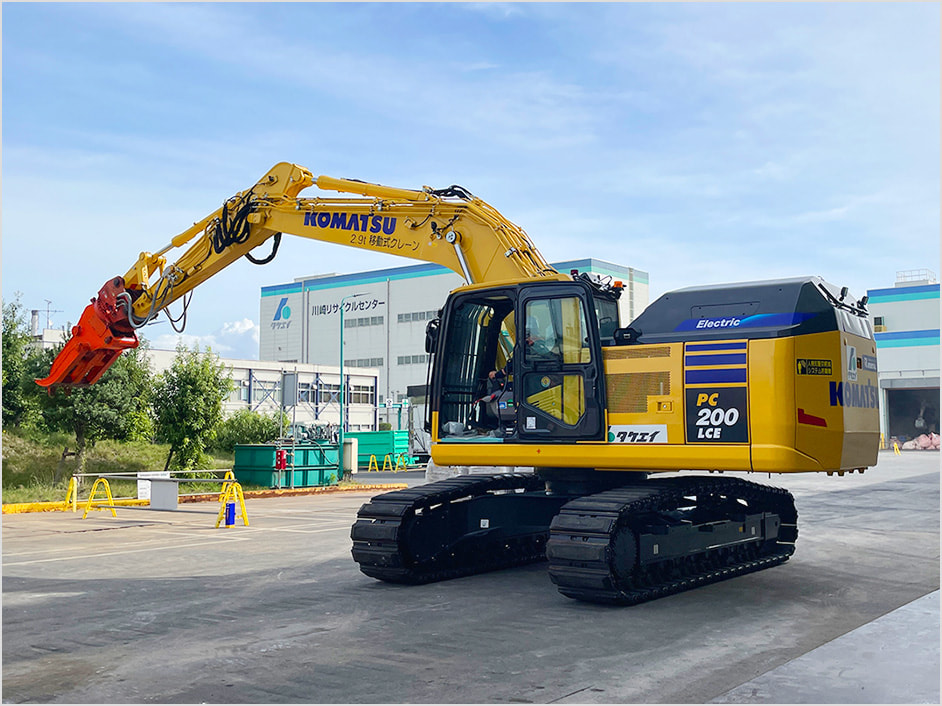
This trial was performed at the recycling center in order to obtain continuous data on
the excavator’s durability, safety, and environmental performance under the work environment of a waste
treatment facility.
The electricity used to charge the excavator is partially generated in-house by solar panels installed
at the center, further contributing to the reduction of CO2 emissions.
Response to Climate Change Information disclosure based on TCFD recommendations
Basic approach
TRE HOLDINGS is fully aware of the impact of climate change, including associated environmental destruction and the need for countermeasures. Accordingly, we have set the realization of “an efficient recycling society” and “a carbon-neutral society” as material issues. In fiscal 2022, we expressed our support for the Task Force on Climate-related Financial Disclosures (TCFD). Although society and markets are increasingly acting to achieve carbon neutrality, abnormal weather events and flood damage are already growing more severe. We will continue our efforts to help resolve societal challenges related to climate change via our business, including contributing to disaster recovery efforts.
Governance
The TRE Group has established the CSR and Sustainability Committee as an organization to set targets and plan, announce, execute, and evaluate strategies concerning the Group’s climate change countermeasures and other initiatives aimed at solving social issues. The CSR and Sustainability Committee is chaired by the President and COO. As the body for deliberating sustainability-related initiatives, its functions include determining relevant policies and managing the progress of targets. It meets at least twice a year, in principle, and reports to the Board of Directors after holding discussions and obtaining a consensus at Group management meetings. The Board of Directors supervises the progress of targets and policies.
Risk management
The CSR and Sustainability Committee discusses the impact of the risks and opportunities of climate change on the Group’s business and how to manage those risks going forward, and the results are disclosed in this integrated report.
Strategy
The Group seeks to understand the risks and opportunities posed to business by the migration risks and physical risks of climate change, and to reflect that understanding in business strategies and in the planning of climate change countermeasures. The results of the climate change risk impact analysis indicate that for the Group, which is engaged in waste treatment, recycling and renewable energy businesses, the risks posed by climate change to business continuity are significantly outweighed by the business opportunities, which are linked to future growth opportunities.
In accordance with TCFD recommendations, we also conduct scenario analysis to identify climate change-related risks and opportunities. During this scenario analysis, we defined a 1.5°C scenario and a 4°C scenario based on scientific evidence from the International Energy Agency (IEA) and other sources, and estimated the following three items to evaluate the magnitude of climate-related risks and opportunities that may affect our business in 2030.
Migration risks
Financial impact of the introduction of carbon pricing
We estimated the impact of the introduction of a carbon tax on CO2 emissions, based on the assumption that CO2 emissions in 2030 will remain at the same level as in 2013.
Financial impact of changes in electricity prices
We estimated the impact of reducing our total electricity consumption in 2030 compared to 2021 levels through energy saving initiatives and the introduction of solar power generation systems for on-site consumption, as well as the effect of adopting 100% renewable energy for the remainder of our electricity consumption.
Physical risks
Impact of business suspension due to flooding and storm surge damage
We used hazard maps to determine information such as the depth of inundation due to storm surges and flooding as well as river class based on the address of each of our business sites, and estimated the amount of damage due to business suspension at each location based on the number of days of full or partial business suspension in accordance with the depth of inundation, then multiplied this by the annual probability that levels will be exceeded in accordance with the relevant river class to estimate the average annual amount of damage due to business suspension.
Under the 1.5°C scenario, we anticipate a significant cost increase due to carbon taxes. At the same time, our qualitative assessment also indicates an increase in business opportunities. With regard to physical risks, we also anticipate an increase in such risks due to climate change. In light of the fact that the Group’s businesses contribute to conserving the global environment, including climate change countermeasures, we have established the creation of an efficient recycling, carbon-neutral society as material issues to address, and we will focus on reducing the risks of climate change while seizing business opportunities.
Indicators and targets
We have set targets for CO2 emission reductions among our KPIs.
- Achieve net zero CO2 emissions (Scope 2) by 2026.
- Reduce net CO2 emissions (Scope 1+2) by 46% or more by 2030 compared to FY2013.
- Achieve net zero CO2 emissions (Scope 1+2+3) by 2050.
We also calculate CO2 emissions as an assessment metric for
evaluating climate change-related risks and opportunities. The data on Scope 1, 2, and 3 CO2
emissions and recycling efficiency is assured by SOCOTEC Certification Japan, an independent
third-party organization, in order to ensure the reliability of calculations.
Scope of assurance:Calculation of CO2 emissions (Scope 1, 2, and 3) and recycling
efficiency for TRE HOLDINGS and its 28 consolidated subsidiaries in FY2023
Assurance level: Limited assurance
| Broad category |
Intermediate category |
Subcategory | Risks/ Opportunities |
Impact on the TRE Group |
Assessment | Time of impact |
||
|---|---|---|---|---|---|---|---|---|
| 1.5℃ | 4℃ | Quali- tative |
||||||
| Migration risks |
Policies and regulations |
Stricter regulations such as carbon taxes and greenhouse gas emissions quotas |
Risks |
|
Major | Minor | Mid/long-term | |
| Opportunities |
|
ー | ー | Major | ||||
| Stricter environmental laws and regulations |
Risks |
|
ー | ー | Minor | Short-to long-term |
||
| Opportunities |
|
ー | ー | Major | ||||
| Stricter information disclosure obligations |
Risks |
|
ー | ー | Minor | Short-to long-term |
||
| Opportunities |
|
ー | ー | Minor | ||||
| Market | Sharp increases in resource prices |
Risks |
|
Medium | Minor | Short-to mid-term |
||
| Opportunities |
|
ー | ー | Medium | ||||
| Physical risks |
Acute | Intensification and frequent occurrence of natural disasters |
Risks |
|
ー | ー | Major | Short-to long-term |
| Opportunities |
|
ー | ー | Minor | ||||
| Chronic | Rise in average temperature, frequent floods, and storm surges |
Risks |
|
ー | ー | Major | Mid/ long-term |
|
| Risks |
|
Medium | Major | |||||
| Opportunities |
|
ー | ー | Minor | ||||
